
Know what to make and what to buy
The decision gets made on a standard cost that was set once and a supplier quote that arrived by email. Both are defensible. Neither is what the part costs you this year.
Your cost, from what actually happened
The numbers that decide this exist. Material consumption and labour hours are in the ERP. Run times, setup and scrap are in the systems on the floor. Supplier pricing and delivery history are in purchasing, and often in a workbook beside it. What does not exist is the one place that puts them next to each other, because building it means joining four sources and nobody owns that work.
Describe it in a sentence and the Flow appears: it reads all of them, joins on part number, and draws the comparison — per part, with the gap in dollars. It runs when someone opens it, so a price change or a bad month shows up the next time the question is asked rather than the next time a spreadsheet is rebuilt.
The cost that is really yours
Material, labour and machine time from the systems that recorded them — not a standard cost set last year and carried forward.
The costs the standard leaves out
Scrap and rework on the part, setup time amortised over the runs you actually make, and the capacity the run consumes.
What the supplier actually charges
Landed price against quoted price, with freight, minimum order quantities and the price breaks you never hit.
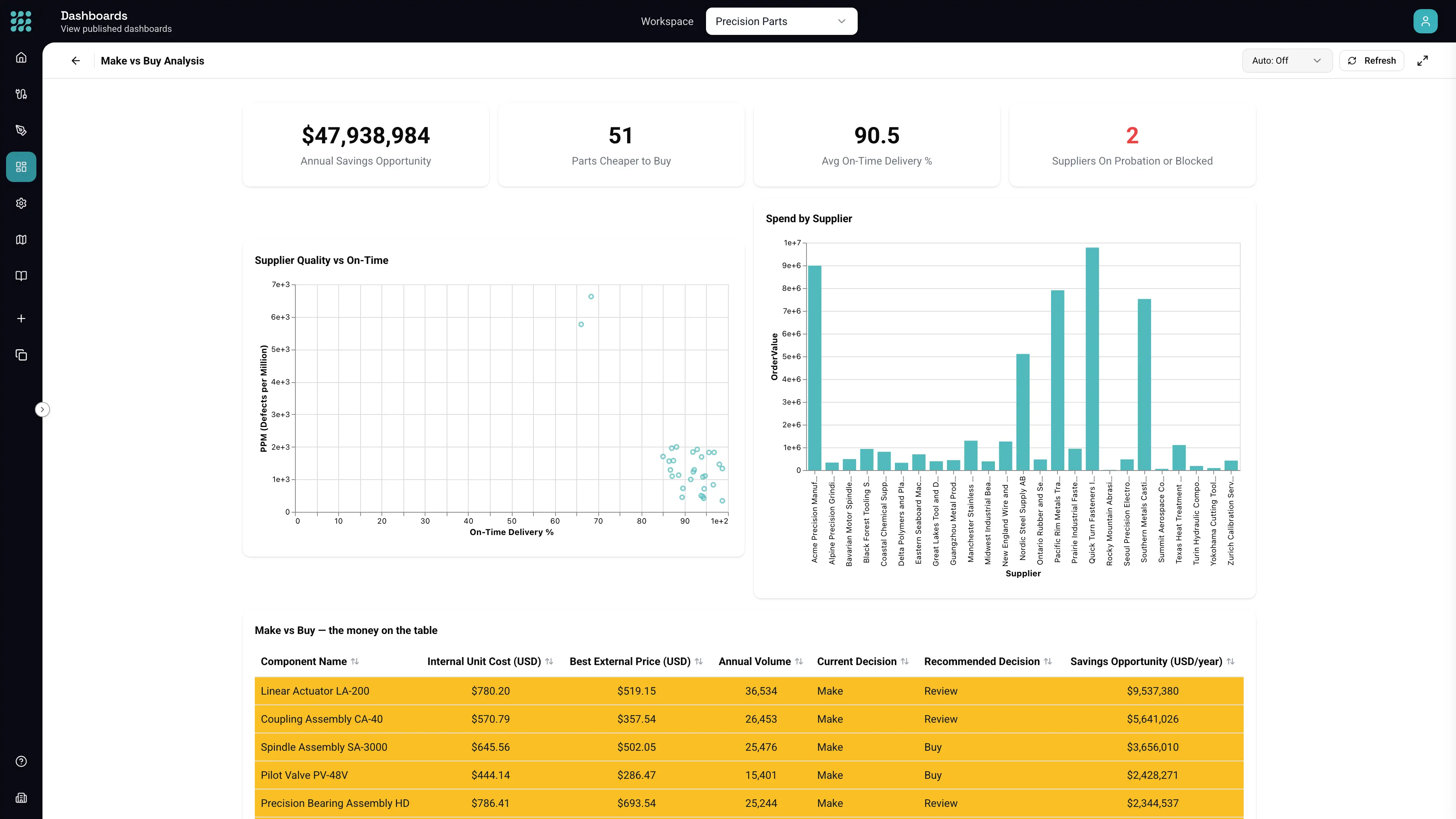
Price is not the only column
A supplier who is nine percent cheaper and eleven percent late is not cheaper. The comparison is only honest with the risk sitting beside the price, on the same page, computed from the same history.
Quality scorecards
Reject rates and returns by supplier, over enough history to tell a bad quarter from a bad supplier.
Delivery performance
On-time against promised, and how far the late ones are late — the number that decides whether you hold safety stock.
Concentration risk
How much of your spend, and how many of your parts, sit behind a single supplier who has no second source.
The output is a list of parts where the current decision and the current numbers disagree — which is a short list, and an actionable one.
Why it is usually done once
Almost every manufacturer has done a make-versus-buy analysis. Fewer have done it twice on the same parts, and that is the whole problem: the analysis is a project, and projects happen when someone has time rather than when the numbers move.
So the decision ages. A supplier raises prices four percent and the part stays bought. A machine comes off a lease and the part stays bought. Volume triples and the price break that justified buying is now three tiers away. None of those are surprises — they are simply changes that happened after the spreadsheet was closed.
The version that runs when someone opens it does not age. The same question, asked in April and again in October, reads the ERP and the purchasing history as they are on the day, so the list of parts worth revisiting is current by construction rather than by someone remembering to rebuild it.
Quarterly, not never
A review that costs nothing to run is a review that actually happens on a cadence. The work moves from producing the analysis to reading it.
Per part, not per category
Category-level averages hide the parts that matter in both directions. The comparison is drawn at the part number, because that is the level the decision is actually made at.
Arguable in the meeting
Every figure traces to the system that recorded it, and drilling into a number shows the rows underneath. Nobody has to take the summary on trust.
Ask it about one part number.
Free to build. Paid when you run it in production.