

The Promise vs. The Reality
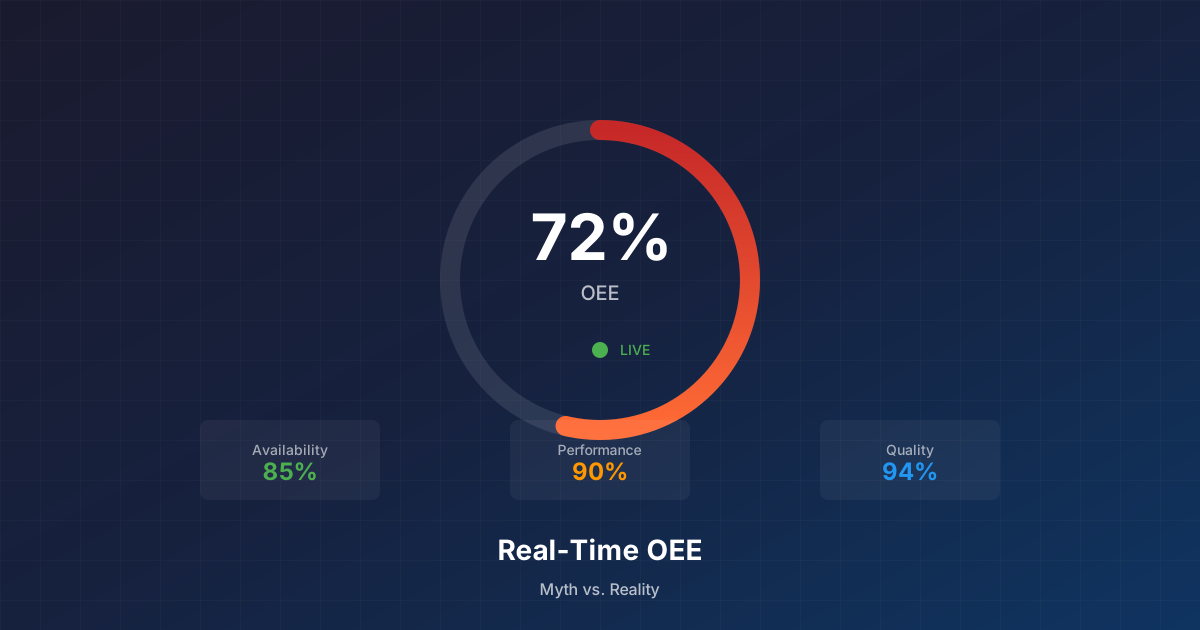
Ask any manufacturing executive about OEE and they’ll tell you it’s critical. Overall Equipment Effectiveness—the combination of availability, performance, and quality—is the universal metric for production efficiency. Everyone measures it. Everyone wants to improve it.
But ask how current their OEE data is, and the answers get interesting. “We calculate it daily.” “We get reports by shift end.” “Our MES shows it, but there’s a lag.”
Real-time OEE has become one of those aspirational goals that everyone talks about but few achieve. And the gap between the promise and the reality is costing manufacturers more than they realize.
What “Real-Time” Actually Means
Let’s be precise about terminology. In manufacturing, “real-time” doesn’t mean instantaneous—physics and network latency make that impossible. What it means is: fast enough to act on.
For OEE, that typically means:
- Availability: Knowing within minutes when a machine goes down and why
- Performance: Seeing cycle time deviations as they happen, not aggregated after the fact
- Quality: Catching defect trends before they become batch-wide problems
If your OEE data is hours old, you’re doing post-mortem analysis, not real-time management. The line has already run slow. The defects have already been made. You’re documenting history instead of changing it.
Why Real-Time OEE Is Hard
The challenge isn’t calculating OEE—the formula is straightforward. The challenge is getting the underlying data fast enough and clean enough to make the calculation meaningful.
Data lives in silos. Availability data comes from the MES or PLC. Quality data comes from inspection systems or manual checks. Performance data requires correlating planned cycle times with actual machine signals. These systems rarely share a common clock, let alone a common database.
Manual inputs create delays. Many plants still rely on operators to log downtime reasons, scrap counts, or changeover completions. Until that data is entered, your OEE calculation is incomplete.
Definitions vary. What counts as downtime? Is a changeover planned or unplanned? How do you handle rework? Different departments often have different answers, and those inconsistencies make real-time aggregation unreliable.
Infrastructure wasn’t designed for speed. Legacy systems were built for batch processing, not streaming data. Extracting information in real-time often means working around architectures that assume nightly data dumps.
The Business Case for Speed
Why does it matter whether you see OEE in real-time versus at shift end? Because the cost of production problems compounds with time.
Consider a simple example: a machine running 10% below standard cycle time. If you catch it in the first hour, you’ve lost 6 minutes of capacity on an hour of production. If you don’t catch it until shift end, you’ve lost 48 minutes across an 8-hour shift—assuming nothing else went wrong.
The same principle applies to quality. A process drift that produces marginal parts will keep producing marginal parts until someone intervenes. The faster you see the trend, the smaller the batch at risk.
Manufacturers who achieve real-time OEE visibility typically report:
- 10-15% reduction in unplanned downtime (faster response to issues)
- 5-10% improvement in overall OEE (better root cause identification)
- 50%+ reduction in time spent preparing production reports (automation)
Getting to Real-Time: A Practical Path
You don’t need to boil the ocean. Start with the data that matters most and expand from there.
Step 1: Connect Machine Signals
Modern PLCs and CNCs can expose availability and cycle data through standard protocols (OPC-UA, MQTT). Connect these signals to a data platform that can process them in real-time. This alone gets you availability and performance visibility without relying on manual input.
Step 2: Automate Quality Data Capture
Wherever possible, replace manual quality logging with automated capture. In-line inspection systems, vision systems, and connected gauges can feed data directly to your OEE calculation without waiting for an operator.
Step 3: Standardize Downtime Coding
Create a consistent taxonomy for downtime reasons and make it easy for operators to log them quickly. Touchscreen interfaces at the machine beat paper logs reviewed hours later. The faster you know why a machine stopped, the faster you can address it.
Step 4: Unify the Data
Bring availability, performance, and quality data into a single platform that can correlate events across sources. This is where integration tools pay off—connecting MES, quality systems, and machine data into a unified view.
Step 5: Display It Where It Matters
Real-time data is useless if no one sees it. Put OEE dashboards on the shop floor where supervisors and operators can act on them. Trigger alerts when metrics deviate from targets.
Both halves of that — a live OEE dashboard and the alert when a line drops below target — can be built from the systems you already have, without a warehouse underneath.
The Bottom Line
Real-time OEE isn’t a technology problem—it’s an integration problem. The data exists in your systems today. The challenge is connecting it, correlating it, and presenting it fast enough to drive action.
Manufacturers who solve this problem don’t just get better reports. They get faster responses, smaller quality escapes, and measurable productivity gains. The investment in real-time visibility pays for itself.
Want to see your OEE in real-time? Book a demo to see how FactoryThread connects your production data.