

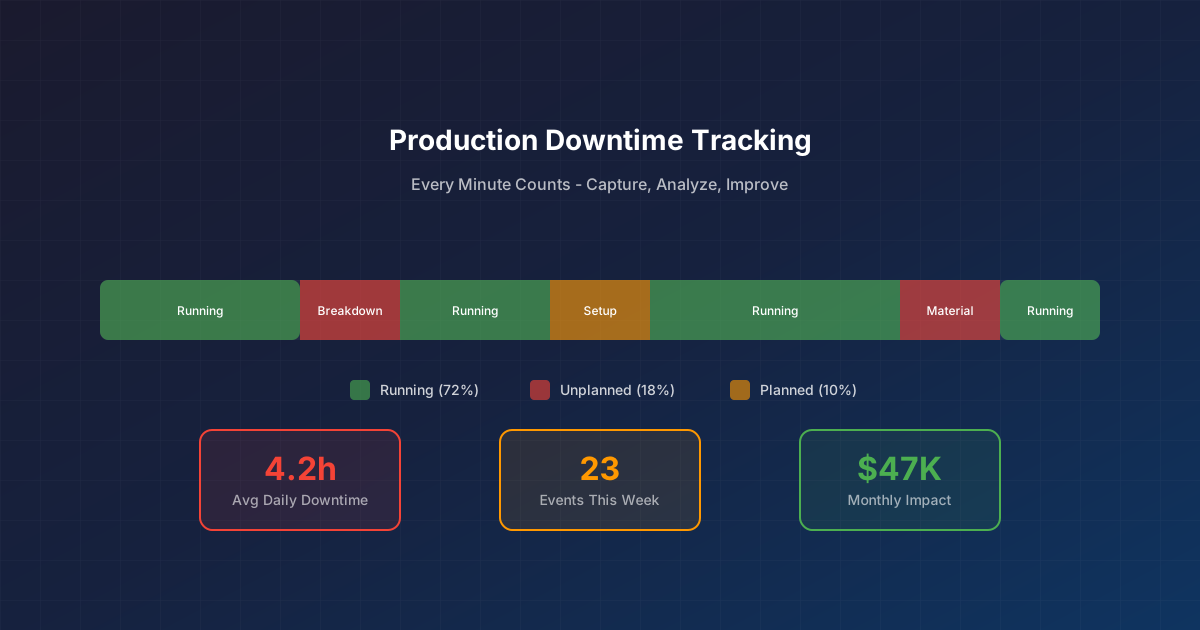
The True Cost of Production Downtime
When a production line stops, the meter runs. Labor costs continue. Overhead allocates. Delivery commitments slip. Depending on the industry, unplanned downtime costs range from $5,000 to $50,000 per hour—and that’s before you count quality issues from restarts or expediting costs for late orders.
Production downtime tracking transforms this cost from an invisible drain into a measurable, improvable metric. You can’t reduce what you don’t measure, and most manufacturers dramatically underestimate their actual downtime.
Types of Production Downtime
Not all downtime is equal. Effective tracking starts with proper categorization:
Planned Downtime
Scheduled stops that are part of normal operations:
- Changeovers: Product or tooling changes
- Preventive maintenance: Scheduled PM activities
- Breaks and meals: Operator-dependent lines
- Meetings and training: Planned production pauses
- No demand: Scheduled non-production time
Planned downtime reduces your available time but isn’t necessarily a problem to solve—it’s often a choice.
Unplanned Downtime
Unexpected stops that represent lost production:
- Equipment failures: Mechanical, electrical, pneumatic breakdowns
- Material shortages: Waiting for materials, components, or packaging
- Quality issues: Stops due to defects or out-of-spec product
- Operator unavailability: Absent operators, slow changeover personnel
- External factors: Utility outages, supplier delays
Unplanned downtime is the primary target for improvement—every minute recovered is additional capacity.
Minor Stops and Speed Losses
Short interruptions that don’t get logged as downtime but still cost capacity:
- Micro-stops: Machine pauses under 5 minutes
- Idling: Machine running but not producing
- Reduced speed: Running below rated capacity
- Small adjustments: Frequent operator interventions
These “hidden factory” losses often exceed tracked downtime but are invisible to traditional tracking.
Setting Up Production Downtime Tracking
Step 1: Define Downtime Categories
Create a standardized taxonomy for downtime reasons. Balance detail (enough to analyze) with usability (operators can quickly select).
Common top-level categories:
- Equipment failure
- Changeover/Setup
- Material/Supply
- Quality/Defect
- Operator/Labor
- External/Utility
- Planned maintenance
- No scheduled production
Each category should have subcategories for specific reasons. “Equipment failure” might include: mechanical, electrical, pneumatic, controls, tooling, etc.
Step 2: Establish Tracking Methods
Manual tracking (operator entry):
- Operators log start/end times and reason codes
- Works for any equipment
- Requires operator discipline
- Typically misses short stops
Semi-automated tracking:
- System detects stops automatically (machine signals)
- Operators add reason codes
- Captures all stops above threshold
- Reason accuracy depends on operators
Fully automated tracking:
- Machine connectivity provides stop detection and fault codes
- System infers reasons from machine data
- Requires machine integration
- May not capture all context
Most plants use a hybrid: automated stop detection with operator reason input.
Step 3: Define Thresholds
What counts as trackable downtime?
- Minimum duration: Stops under 2-5 minutes often aren’t tracked (but should be measured)
- Speed threshold: Below what speed is the line considered “down”?
- Partial operation: How do you handle reduced crew or partial line operation?
Set thresholds that match your operational reality while capturing meaningful losses.
Step 4: Calculate Downtime Metrics
Availability = (Scheduled Time - Downtime) / Scheduled Time
Mean Time Between Failures (MTBF) = Operating Time / Number of Failures
Mean Time To Repair (MTTR) = Total Repair Time / Number of Repairs
Downtime Rate = Downtime Hours / Scheduled Hours
Track these over time and by equipment to identify trends and problem areas.
Analyzing Production Downtime Data
Pareto Analysis
Rank downtime reasons by total time lost. The Pareto principle typically applies: 20% of reasons cause 80% of downtime. Focus improvement efforts on the vital few.
This is the chart worth having live rather than monthly: downtime by reason category beside availability, performance and quality, computed when someone opens it.
Trend Analysis
Plot downtime over time by category:
- Is overall downtime improving or worsening?
- Are specific categories growing?
- Do seasonal patterns exist?
- Did recent changes affect downtime?
Equipment Comparison
Compare similar equipment:
- Which machines have highest downtime?
- What’s different about high-reliability machines?
- Where should maintenance focus?
Shift and Crew Analysis
Compare downtime across shifts:
- Are there skill gaps affecting certain crews?
- Do specific shifts have more changeover time?
- Is downtime tracking consistent across shifts?
Root Cause Analysis
For significant downtime events:
- What failed and why?
- What could have prevented it?
- Are there systemic issues to address?
Use techniques like 5 Whys, fishbone diagrams, and failure mode analysis.
Reducing Production Downtime
Improve Changeover Time (SMED)
Single-Minute Exchange of Die (SMED) methodology:
- Document current changeover process
- Separate internal (machine stopped) from external (machine running) activities
- Convert internal to external where possible
- Streamline remaining internal activities
- Standardize and practice
Many manufacturers cut changeover time 50-80% through systematic SMED.
Implement Preventive Maintenance
Move from reactive to preventive:
- Schedule PM based on time, cycles, or condition
- Use downtime tracking to identify PM opportunities
- Track PM completion and effectiveness
- Adjust PM intervals based on failure data
Pursue Predictive Maintenance
Go beyond preventive with condition-based maintenance:
- Monitor equipment health (vibration, temperature, power)
- Predict failures before they occur
- Schedule repairs at convenient times
- Avoid both unexpected failures and unnecessary PM
Address Material Availability
If material shortages cause downtime:
- Improve inventory visibility
- Adjust safety stock levels
- Address supplier reliability
- Improve internal material flow
Reduce Quality-Related Stops
If quality issues cause downtime:
- Address root causes of defects
- Implement SPC to catch drifts early
- Improve startup procedures
- Train operators on quality requirements
Develop Operator Skills
If operator factors affect downtime:
- Standardize operating procedures
- Cross-train for flexibility
- Improve troubleshooting skills
- Empower operators to address small issues
Common Downtime Tracking Mistakes
Mistake: Inconsistent Reason Coding
Different operators code the same event differently. The data becomes unusable for analysis.
Solution: Train on reason codes. Audit coding regularly. Make codes specific enough to be useful but simple enough to use consistently.
Mistake: Tracking Only Long Stops
Missing short stops hides significant losses. A line with 50 two-minute stops per shift loses as much as one with a single 100-minute failure.
Solution: Lower tracking thresholds. Use automated detection. Track micro-stops separately even if not fully categorized.
Mistake: Tracking Without Acting
Collecting downtime data that no one reviews or acts on wastes effort and breeds cynicism.
Solution: Establish regular review rhythms. Assign owners to top issues. Track improvement actions and results.
Mistake: Blaming Operators
Using downtime data to punish rather than improve creates data quality problems (underreporting) and cultural damage.
Solution: Focus on systems and processes, not individuals. Celebrate improvements. Involve operators in problem-solving.
Mistake: Ignoring Planned Downtime
Accepting planned downtime as fixed ignores improvement opportunities. Changeover time, PM duration, and setup procedures can all improve.
Solution: Track planned downtime with the same rigor as unplanned. Apply improvement methodology to planned events.
The Bottom Line
Production downtime tracking is fundamental to manufacturing improvement. Without accurate downtime data, you’re guessing at problems and solutions.
Effective tracking requires consistent categorization, appropriate automation, and—most importantly—a commitment to act on what the data reveals.
Need better visibility into production downtime? See how FactoryThread connects machine data to give you real-time downtime tracking and analysis.