

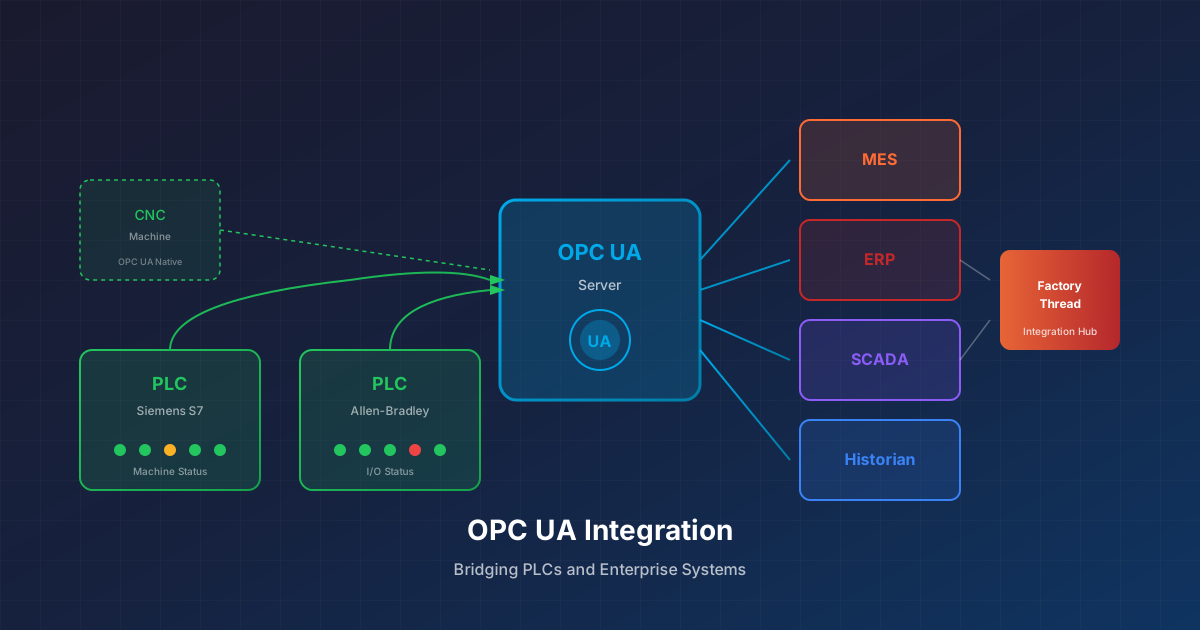
The Shop Floor Data Challenge
Your PLCs know everything happening on the production line. Cycle times, part counts, temperatures, pressures, equipment states—it’s all there, updating in milliseconds.
Your business systems need this data. MES needs production counts. Quality systems need process parameters. ERP needs machine availability. Analytics platforms need everything.
But getting data from PLCs to enterprise applications has historically been painful:
- Proprietary protocols: Each PLC vendor has their own communication method
- Driver complexity: Custom drivers for each device type
- Security concerns: Opening OT networks to IT systems
- Scalability limits: Point-to-point connections don’t scale
- Maintenance burden: Every connection is custom code
This is why OPC UA matters.
What Is OPC UA?
OPC UA (Unified Architecture) is an industrial communication standard designed to solve the interoperability problem. It replaces the older OPC Classic standard with a modern, platform-independent, secure architecture.
Key characteristics:
- Platform independent: Runs on Windows, Linux, embedded systems
- Secure by design: Built-in encryption, authentication, and authorization
- Vendor neutral: Supported by all major automation vendors
- Information modeling: Describes data meaning, not just values
- Scalable: From embedded sensors to enterprise applications
OPC UA provides a standardized way for industrial equipment to expose data that any authorized system can consume.
Why OPC UA for Manufacturing Integration?
Unified Access to All Equipment
Instead of learning proprietary protocols for Siemens, Allen-Bradley, Beckhoff, and Mitsubishi PLCs, OPC UA provides one interface. If the device supports OPC UA (directly or through a gateway), the integration approach is identical.
Security Built In
Traditional industrial protocols assumed air-gapped networks. OPC UA assumes hostile environments:
- Authentication: Verify client and server identity
- Encryption: Protect data in transit
- Authorization: Control who can read or write what
- Audit logging: Track access and changes
This makes OPC UA suitable for IT/OT convergence scenarios where industrial data flows to enterprise networks.
Rich Information Models
OPC UA doesn’t just transmit values—it describes what those values mean:
- Data types and units
- Valid ranges and engineering units
- Relationships between data points
- Equipment hierarchies
Consuming applications understand the data without custom documentation.
Cross-Platform Compatibility
OPC UA servers and clients run on:
- Windows servers and workstations
- Linux-based MES and SCADA systems
- Edge devices and gateways
- Cloud platforms
Data can flow from shop floor equipment through edge computing to cloud analytics—all using the same standard.
Common OPC UA Integration Patterns
Pattern 1: PLC to MES
Scenario: MES needs production counts, cycle times, and machine states from PLCs.
Traditional approach:
- Custom drivers for each PLC type
- Polling-based data collection
- Vendor-specific configuration
OPC UA approach:
- PLCs expose OPC UA server (native or via gateway)
- MES connects as OPC UA client
- Subscription-based updates (data pushed on change)
- Standard security and discovery
Benefits: Faster implementation, vendor-agnostic MES, real-time updates.
Pattern 2: Equipment to Historian
Scenario: Process historian needs high-frequency equipment data for trend analysis.
Traditional approach:
- OPC Classic connections (DCOM-based, Windows-only)
- Historian-specific adapters
- Complex firewall rules
OPC UA approach:
- OPC UA aggregation server collects from multiple sources
- Historian subscribes to aggregated data
- Secure, firewall-friendly communication
- Platform-independent collection
Benefits: Reduced infrastructure complexity, improved security posture.
Pattern 3: Shop Floor to Cloud
Scenario: Cloud analytics platform needs equipment data for predictive maintenance.
Traditional approach:
- On-premises middleware to extract data
- Custom cloud connectors
- VPN or direct connections
OPC UA approach:
- Edge gateway with OPC UA client
- Gateway transforms and forwards to cloud
- OPC UA over MQTT or HTTPS for cloud transport
- Maintained device models in cloud
Benefits: Standardized edge-to-cloud path, preserved data semantics.
Pattern 4: Quality System Integration
Scenario: Quality system needs process parameters linked to lot numbers for traceability.
Traditional approach:
- Manual data entry of process values
- Periodic extracts from historian
- Disconnected timestamps
OPC UA approach:
- Quality system subscribes to relevant process tags
- Lot context passed to OPC UA server
- Real-time parameter capture with production context
- Automatic association in quality records
Benefits: Accurate traceability, no manual entry, real-time capture.
OPC UA Architecture Components
OPC UA Server
The server exposes data from equipment or systems:
- Native servers: Built into modern PLCs and devices
- Gateway servers: Convert proprietary protocols to OPC UA
- Aggregation servers: Combine data from multiple sources
Servers define an “address space”—the collection of data points (nodes) available for access.
OPC UA Client
The client consumes data from servers:
- Direct clients: Applications with built-in OPC UA support
- Middleware clients: Integration platforms that bridge OPC UA to other systems
- Browser/diagnostic clients: Tools for testing and troubleshooting
Information Model
OPC UA uses a hierarchical model to organize data:
- Objects: Logical groupings (equipment, lines, areas)
- Variables: Data points (temperature, count, state)
- Methods: Actions that can be invoked
- References: Relationships between nodes
Well-designed information models make data self-documenting.
Security Model
OPC UA security operates at multiple levels:
- Transport security: TLS encryption for data in transit
- Message security: Signing and encryption of messages
- User authentication: Identity verification (username/password, certificates)
- Authorization: Role-based access to specific nodes
Organizations define security policies matching their risk tolerance.
Implementation Considerations
Direct PLC Support vs. Gateway
Modern PLCs with native OPC UA:
- Siemens S7-1500 series
- Allen-Bradley ControlLogix (with module)
- Beckhoff TwinCAT
- Many others
Older PLCs requiring gateways:
- Siemens S7-300/400
- Allen-Bradley PLC-5, SLC
- Most legacy equipment
Evaluate whether native support is available before purchasing gateway infrastructure.
Data Selection
Not everything in a PLC should be exposed:
- Identify data points needed by consuming applications
- Avoid exposing internal logic variables
- Consider update rates (some data changes rarely)
- Document tag naming conventions
Start with essential data; expand based on demonstrated need.
Performance Planning
OPC UA is efficient, but planning still matters:
- Subscription intervals: How often do consumers need updates?
- Sampling rates: How often should the server sample source data?
- Queue sizes: How much data should buffer during network issues?
- Node count: How many data points will be exposed?
Match performance configuration to actual requirements.
Security Architecture
Plan security before deployment:
- Certificate management: How will server/client certificates be issued and maintained?
- User management: Who can access what data? How are credentials managed?
- Network segmentation: Where does OPC UA traffic flow? What firewalls are involved?
- Audit requirements: What access must be logged? How long retained?
OPC UA security is powerful but must be configured correctly.
OPC UA and Data Integration Platforms
The Role of Integration Platforms
OPC UA solves the equipment communication problem. Data integration platforms solve the next set of challenges:
- Data transformation: Convert PLC data models to business formats
- Multi-source combination: Join equipment data with MES, ERP, quality data
- Scheduling and orchestration: Run data flows on schedules or triggers
- Delivery: Publish combined data to consumers (APIs, dashboards, applications)
How Integration Platforms Use OPC UA
A data integration platform with OPC UA support can:
- Connect to OPC UA servers across the plant
- Subscribe to relevant data points
- Correlate equipment data with business context (orders, lots, products)
- Transform into formats needed by consuming systems
- Deliver via REST APIs, OData, databases, or other channels
This bridges the gap between OT’s equipment-centric data and IT’s business-centric applications.
Getting Started with OPC UA
Step 1: Inventory Your Equipment
Document what you have:
- Equipment types and vendors
- Current PLC models and firmware
- Existing connectivity (OPC Classic, proprietary)
- Data currently being collected
Step 2: Assess OPC UA Readiness
For each equipment type:
- Does it support OPC UA natively?
- If not, what gateway options exist?
- What firmware upgrades might be needed?
- What licensing applies?
Step 3: Define Use Cases
What business problems will OPC UA solve?
- Real-time production visibility
- Automated quality data collection
- Predictive maintenance analytics
- Energy monitoring
Prioritize use cases by business value and implementation complexity.
Step 4: Design the Architecture
Plan your OPC UA infrastructure:
- Where will servers run (on-device, gateway, aggregation)?
- How will clients connect (direct, through middleware)?
- What security model applies?
- How will certificates be managed?
Step 5: Pilot and Expand
Start small:
- Single line or work center
- Limited data points
- One consuming application
Prove value, learn lessons, then expand.
Common Pitfalls
Exposing Everything
Just because a PLC has 10,000 tags doesn’t mean you need to expose all of them. Large address spaces increase discovery time, memory usage, and attack surface. Be selective.
Ignoring Security
OPC UA can be deployed with minimal security—don’t do this. Take advantage of the built-in security features. The effort now prevents incidents later.
Mismatched Expectations
OPC UA provides communication infrastructure, not complete integration. You still need to:
- Map equipment data to business meaning
- Handle error cases and exceptions
- Transform formats for consumers
- Monitor and maintain connections
Plan for the complete solution, not just connectivity.
Neglecting Information Modeling
Poorly organized address spaces are hard to navigate and maintain. Invest in proper information modeling that reflects your physical equipment hierarchy and naming conventions.
The Future of OPC UA
OPC UA continues to evolve:
- OPC UA over MQTT: Pub/sub model for cloud and edge scenarios
- OPC UA for cloud: Standardized cloud connectivity patterns
- Industry companion specifications: Standardized models for specific equipment types
- Field-level communication (FLC): OPC UA directly on sensors and actuators
The standard is becoming the universal language for industrial data.
Ready to connect your shop floor equipment to enterprise systems? See how FactoryThread integrates OPC UA data with MES, ERP, and analytics platforms.