

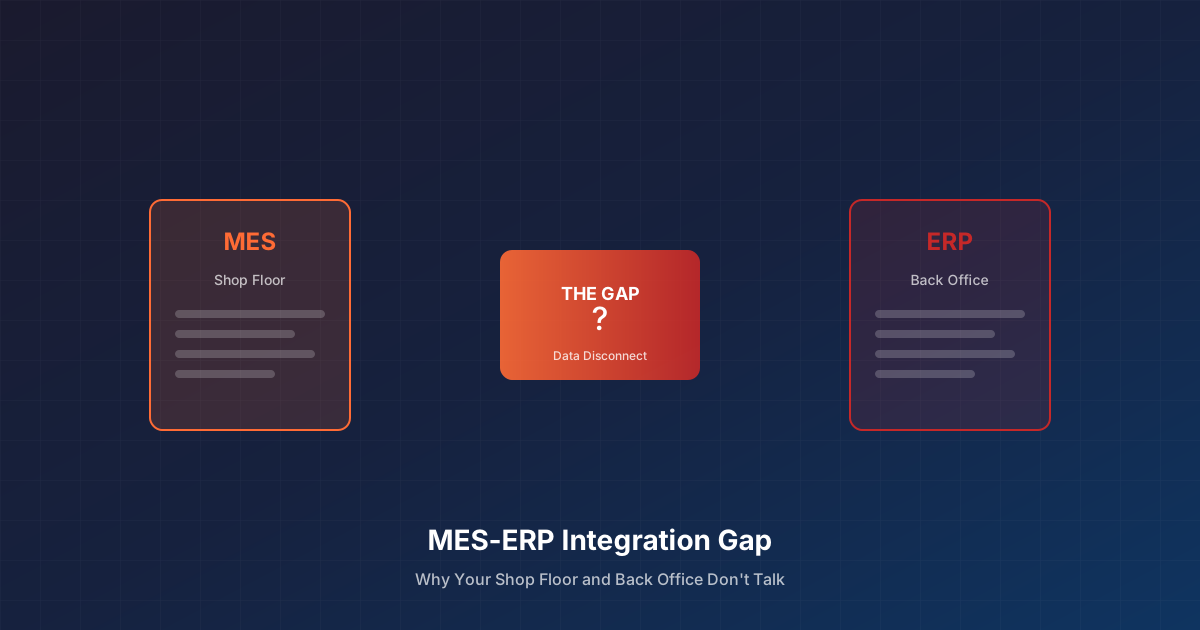
The Uncomfortable Truth
Walk into any mid-to-large manufacturing facility and you’ll find two systems that should be best friends: the Manufacturing Execution System (MES) tracking everything on the shop floor, and the Enterprise Resource Planning (ERP) system running the business. Both are essential. Both are expensive. And in most plants, they barely communicate.
The MES knows exactly what’s happening in production—cycle times, machine states, quality checks, operator actions. The ERP knows what’s supposed to happen—work orders, material availability, customer commitments, costs. But getting information from one to the other? That’s where things break down.
Why the Gap Persists
Different worlds, different languages. MES systems speak in machine cycles, part counts, and downtime codes. ERP systems speak in cost centers, inventory transactions, and order statuses. Translating between them isn’t just a technical problem—it requires someone who understands both worlds.
Integration projects are expensive. A typical MES-ERP integration project runs six months to two years and costs anywhere from $500K to several million dollars. That’s before you factor in the ongoing maintenance as both systems evolve.
Point-to-point connections are fragile. Most plants that do have integration built custom connections years ago. Those connections work—until someone upgrades the MES, patches the ERP, or changes a data structure. Then they break, and the original developer is long gone.
IT is overwhelmed. Manufacturing IT teams are stretched thin. Between keeping production systems running, managing cybersecurity, and supporting a hundred other business needs, MES-ERP integration rarely makes it to the top of the priority list.
The Real Cost of Disconnection
The gap isn’t just an IT problem. It’s a business problem with measurable impact:
Manual data re-entry. Production supervisors spend hours every shift transcribing data from MES screens into ERP transactions. It’s tedious, error-prone, and a waste of skilled labor.
Delayed visibility. When production data doesn’t flow automatically, reports are always behind. Daily production meetings rely on yesterday’s numbers. Finance closes the books with estimates instead of actuals.
Inventory discrepancies. Without real-time consumption data from the shop floor, ERP inventory counts drift. You end up with phantom stock, surprise shortages, and expediting costs.
Quality blind spots. Quality issues caught in the MES often don’t make it back to ERP in time to stop shipments or trigger supplier actions. The disconnect between quality events and business responses costs money.
What’s Changing
The good news: connecting MES and ERP is getting easier. Not because the systems themselves have gotten simpler—they haven’t—but because the integration approach is evolving.
In practice this is what it looks like: work orders, BOMs and completions moving between ERP and MES on a schedule, described in a sentence rather than built as a project.
API-first architecture. Modern MES and ERP systems expose more functionality through APIs. Instead of deep database integrations, you can connect at the application layer with better stability.
Pre-built connectors. Integration platforms now offer out-of-the-box connectors for common manufacturing systems. You’re not starting from scratch anymore.
Visual integration tools. Drag-and-drop interfaces let subject matter experts—not just developers—build and maintain data flows. The person who understands the business process can now implement it.
Cloud and edge options. You’re no longer limited to on-premise integration servers. Cloud platforms handle the heavy lifting while edge deployments keep sensitive data local.
Getting Started
If you’re living with the MES-ERP gap, here’s a practical path forward:
Start with high-value data flows. Don’t try to integrate everything at once. Pick one or two data exchanges that cause the most pain—work order status updates, material consumption, production quantities—and prove the value there first.
Involve operations early. The people who feel the gap most acutely—production supervisors, planners, quality engineers—know exactly what data needs to flow and when. Their input prevents technical solutions that miss the business need.
Plan for change. Whatever you build will need to evolve. Choose an integration approach that lets you modify flows without major development projects.
Measure the baseline. Before you start, document how long things take today. How many hours of manual data entry? How stale are the reports? What’s the inventory accuracy? You’ll want those numbers to prove ROI later.
The Bottom Line
The MES-ERP gap isn’t a new problem, but it’s increasingly unacceptable. Manufacturers competing on speed, quality, and efficiency can’t afford to run their shop floor and back office as separate islands. The technology to bridge the gap exists today. The question is whether your organization is ready to prioritize it.
Struggling with MES-ERP integration? See how FactoryThread connects manufacturing systems without the typical integration headaches.