

Digital Twin: Cutting Through the Hype
“Digital twin” has become one of the most overused terms in manufacturing technology. Vendors slap the label on everything from 3D CAD models to basic dashboards. The concept has been so diluted that many manufacturers either dismiss it as marketing fluff or invest in “digital twins” that deliver little value.
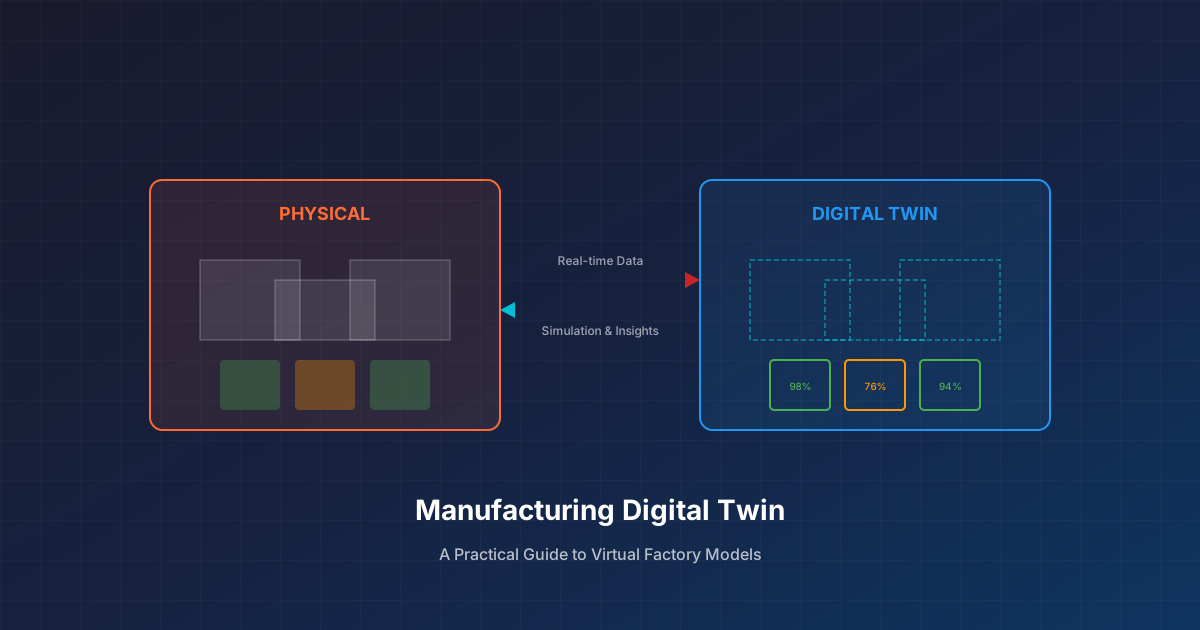
Let’s cut through the noise. A manufacturing digital twin is a virtual representation of a physical asset, process, or system that uses real-time data to mirror actual behavior. The key word is “real-time”—a static model isn’t a digital twin; it’s just a model.
Digital twins enable:
- Monitoring: See what’s happening right now
- Simulation: Test scenarios without affecting production
- Prediction: Anticipate what will happen next
- Optimization: Find better ways to operate
The question isn’t whether digital twins are valuable—it’s whether they’re valuable for you, right now, given your data infrastructure and improvement priorities.
Types of Manufacturing Digital Twins
Asset Digital Twins
Virtual representations of individual equipment:
- CNC machines, robots, conveyors, packaging lines
- Reflect current operating state (running, idle, fault)
- Include configuration, parameters, and performance data
- Enable predictive maintenance and performance optimization
Example: A digital twin of a CNC machine showing current program, spindle load, tool wear status, and predicted remaining tool life.
Process Digital Twins
Models of manufacturing processes:
- Chemical reactions, heat treatment, assembly sequences
- Simulate process behavior based on inputs
- Predict outputs and quality based on parameters
- Enable process optimization and troubleshooting
Example: A digital twin of a heat treatment furnace predicting metallurgical properties based on temperature profile, atmosphere, and material composition.
Production Digital Twins
Models of production flow:
- Work-in-process locations and quantities
- Machine states and queue lengths
- Material flow and bottlenecks
- Scheduling and capacity scenarios
Example: A digital twin of a production line showing real-time WIP, predicted completion times, and simulated impact of adding a shift.
Factory Digital Twins
Comprehensive models of entire facilities:
- All equipment, processes, and flows
- Utility systems and infrastructure
- Layout and material handling
- Multi-scenario simulation
Example: A digital twin of a factory showing real-time production status, energy consumption, and simulated impact of layout changes.
What Digital Twins Actually Require
Prerequisite 1: Connected Data
Digital twins are only as good as their data feeds. You need:
- Machine connectivity: Real-time signals from equipment
- System integration: Data from MES, ERP, quality systems
- Sensor coverage: Measurements for parameters you want to model
- Data infrastructure: Platform to collect, store, and process data
If your production data lives in spreadsheets and disconnected systems, you’re not ready for digital twins. Fix the data foundation first.
Prerequisite 2: Defined Models
A digital twin needs logic to interpret data and simulate behavior:
- Physical models: Equations describing how the system behaves
- Statistical models: Relationships derived from historical data
- Hybrid models: Combinations of physics and statistics
- AI/ML models: Learned patterns from operational data
Model complexity should match the problem. Simple dashboards don’t need physics simulations; predictive maintenance might.
Prerequisite 3: Integration Architecture
Digital twins must connect to multiple systems:
- Data sources: Machines, sensors, systems
- Execution systems: MES, SCADA, automation
- Decision support: Dashboards, alerts, recommendations
- Simulation tools: Scenario testing, optimization
This requires an integration platform that can handle real-time data flows, historical storage, and bidirectional communication.
Prerequisite 4: Organizational Capability
Technology is the easy part. You also need:
- Skills: People who can build, maintain, and use digital twins
- Processes: Workflows that incorporate digital twin insights
- Culture: Willingness to trust and act on model outputs
- Governance: Ownership, maintenance, and accuracy standards
Where Digital Twins Deliver Real Value
High-Value Use Case: Predictive Maintenance
Digital twins of critical equipment that:
- Monitor real-time condition (vibration, temperature, power)
- Compare to normal operating patterns
- Predict failures before they occur
- Recommend maintenance actions
Value: Reduced unplanned downtime, extended equipment life, optimized maintenance spending.
Requirements: Condition monitoring sensors, failure history data, maintenance integration.
High-Value Use Case: Process Optimization
Digital twins of complex processes that:
- Model relationship between inputs and outputs
- Simulate impact of parameter changes
- Identify optimal operating points
- Detect process drift
Value: Improved yield, reduced energy consumption, better quality consistency.
Requirements: Process sensors, quality data, historical correlation analysis.
High-Value Use Case: Production Scheduling
Digital twins of production flow that:
- Reflect current WIP and machine states
- Simulate schedule alternatives
- Predict completion times and bottlenecks
- Support what-if analysis
Value: Better on-time delivery, improved resource utilization, faster response to disruptions.
Requirements: Real-time production tracking, machine status, order information.
High-Value Use Case: Virtual Commissioning
Digital twins of new equipment or lines that:
- Simulate behavior before physical installation
- Test control logic and programming
- Train operators before startup
- Reduce commissioning time
Value: Faster startups, reduced commissioning risk, better operator readiness.
Requirements: Detailed equipment models, control system integration, simulation environment.
Where Digital Twins Disappoint
Low-Value Application: Visualization Without Action
Impressive 3D models that show production status but don’t enable better decisions. If the digital twin is just a fancy dashboard, you’ve invested heavily for marginal benefit.
Low-Value Application: Models Without Data
Physics-based simulations that run on assumptions rather than real operational data. Theoretical models are useful for design; they’re less useful for operations unless calibrated with actual data.
Low-Value Application: Pilots Without Scale
Proof-of-concept digital twins for one machine or process that never expand. The learning is valuable, but the business impact requires scale.
Low-Value Application: Technology Without Process
Digital twins that provide insights no one acts on. If there’s no process to respond to predictions or recommendations, the technology is wasted.
A Pragmatic Path to Digital Twins
Start with Data Infrastructure
Before pursuing digital twins, ensure you can:
- Collect real-time data from equipment
- Integrate data from production systems
- Store and retrieve historical data
- Calculate basic metrics (OEE, yield, throughput)
This foundation enables digital twins and delivers value independently.
Pick a Bounded Problem
Choose a specific, valuable problem:
- One critical machine for predictive maintenance
- One complex process for optimization
- One production area for flow simulation
Bounded problems are achievable and demonstrate value.
Build or Buy Appropriately
Options for digital twin technology:
- Build custom: Maximum flexibility, highest effort
- Platform-based: Pre-built capabilities, requires integration
- Vendor solutions: Turnkey for specific equipment, limited customization
Match the approach to your capabilities and the complexity of the problem.
Plan for Operations
Digital twins require ongoing maintenance:
- Model calibration as processes change
- Integration updates as systems evolve
- User training as capabilities expand
- Accuracy monitoring to maintain trust
Budget for operations, not just implementation.
The Bottom Line
Digital twins are a powerful concept—when applied to real problems with adequate data infrastructure. They’re not magic, and they’re not universally applicable.
Start with your data foundation. Pick specific, valuable problems. Build capability incrementally. That’s the pragmatic path to digital twin value.
Building your manufacturing data foundation? See how FactoryThread connects production systems to enable digital twin initiatives.