

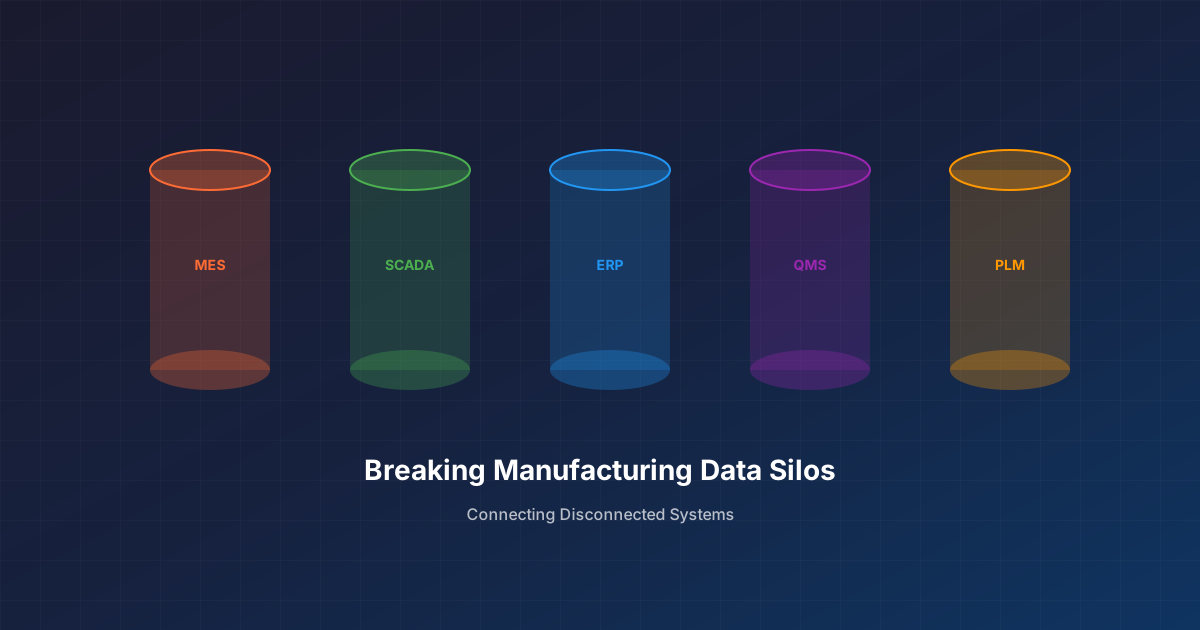
The Silo Problem Nobody Talks About
Manufacturing has a dirty secret: despite decades of digitization, most plants run on disconnected systems. The MES doesn’t talk to the ERP. The quality system doesn’t talk to the historian. Production data lives in spreadsheets on a supervisor’s desktop. And everyone wastes hours every week hunting for information that should be at their fingertips.
Data silos aren’t a technology failure—they’re an accumulation of reasonable decisions made over time. Each system was purchased to solve a specific problem. Each was the best choice for its domain. But nobody planned for how they’d all work together, and now the integration debt is coming due.
How Silos Form
Understanding how you got here helps explain why the problem persists.
Best-of-breed purchasing. You bought the best MES for your industry, the best quality system for your compliance needs, the best historian for your process data. Each vendor optimized for their domain, not for interoperability.
Departmental ownership. Operations owns the MES. Engineering owns the historian. Quality owns the QMS. IT owns the ERP. Each department configured their system for their workflows, with little coordination across boundaries.
Organic growth. Plants expand. Product lines change. Acquisitions happen. Each change adds systems, rarely removes them. That legacy quality database from 2008? Still running because someone still needs the data.
Integration is expensive. Every time someone proposed connecting two systems, the cost and complexity pushed it to the back burner. “We’ll do it next year” became “we’ll do it eventually” became “we’ve always worked around it.”
The Real Cost of Disconnection
Silos impose a tax on everything you do. It’s often invisible because it’s baked into how people work, but it’s very real.
Time Tax
Every report that requires pulling data from multiple systems costs time. Every meeting that starts with “let me check the other system” costs time. Industry studies suggest manufacturing employees spend 20-30% of their time searching for, reconciling, or re-entering information across systems.
The re-entering half of that tax is the easiest to remove first: give the retyping to a Flow and the two systems stay in step without a person in the middle.
Accuracy Tax
Manual data transfer introduces errors. Copy-paste mistakes. Transposition errors. Outdated source files. When systems don’t reconcile automatically, discrepancies accumulate until someone notices—usually during an audit or customer complaint.
Speed Tax
Decisions wait for data. When getting a complete picture requires querying multiple systems and reconciling the results, you either make decisions with incomplete information or you wait. Neither is optimal.
Flexibility Tax
Changing processes means changing multiple systems. Adding a new data field, modifying a workflow, or implementing a new metric requires coordination across silos. What should take days takes months.
Why Traditional Integration Fails
If silos are so costly, why hasn’t everyone solved this already? Because traditional integration approaches have their own problems.
Point-to-point integrations don’t scale. Connecting system A to system B seems manageable. But with 10 systems, you potentially need 45 connections. Each one is a custom project. Each one breaks when either system changes.
Enterprise integration projects are massive. The “rip and replace” approach—implementing a unified platform across the enterprise—takes years and costs millions. Many such projects fail or deliver far less than promised.
Middleware requires specialists. Traditional ESB (Enterprise Service Bus) and integration platforms require dedicated developers to build and maintain. That expertise is expensive and often not available.
Data warehouses are too slow. Building a central data warehouse consolidates information but introduces latency. Nightly batch loads don’t help when you need real-time visibility.
A Better Approach
Breaking down silos doesn’t require replacing all your systems or hiring an army of integration specialists. It requires changing how you think about data connectivity.
Focus on Data Flows, Not Systems
Instead of trying to fully integrate every system, identify the specific data that needs to move between them. Work order status from MES to ERP. Quality results from inspection to MES. Production counts from PLC to historian. Solve these specific flows rather than boiling the ocean.
Embrace APIs
Modern systems expose their data through APIs (Application Programming Interfaces). APIs are more stable than database-level integration—they’re designed for external access and tend to survive upgrades better. Prioritize API-based connections wherever possible.
Implement an Integration Layer
Rather than point-to-point connections, route data through a central integration platform. This creates a single place to manage, monitor, and modify data flows. When a source system changes, you update one connection instead of many.
Enable Self-Service
The people who understand data needs best—process engineers, quality managers, production supervisors—often can’t implement integrations themselves. Modern low-code integration tools change this. Visual interfaces let domain experts build and modify data flows without writing code.
Start Small, Prove Value
Pick one painful silo—the one that causes the most frustration or costs the most time. Connect it. Measure the improvement. Use that success to build momentum for broader integration efforts.
Breaking Free
Data silos aren’t inevitable. They’re a consequence of decisions that made sense individually but created problems collectively. Breaking them down requires acknowledging the accumulated integration debt and committing to pay it off incrementally.
The manufacturers who thrive in the coming decade will be those who can leverage their data across boundaries—connecting shop floor to top floor, correlating quality with process, linking production with supply chain. That’s only possible when the silos come down.
Ready to connect your manufacturing data? See how FactoryThread breaks down silos without massive integration projects.